
Clinton is Co-Founder and CEO, Heatwve; Blu Skye alum
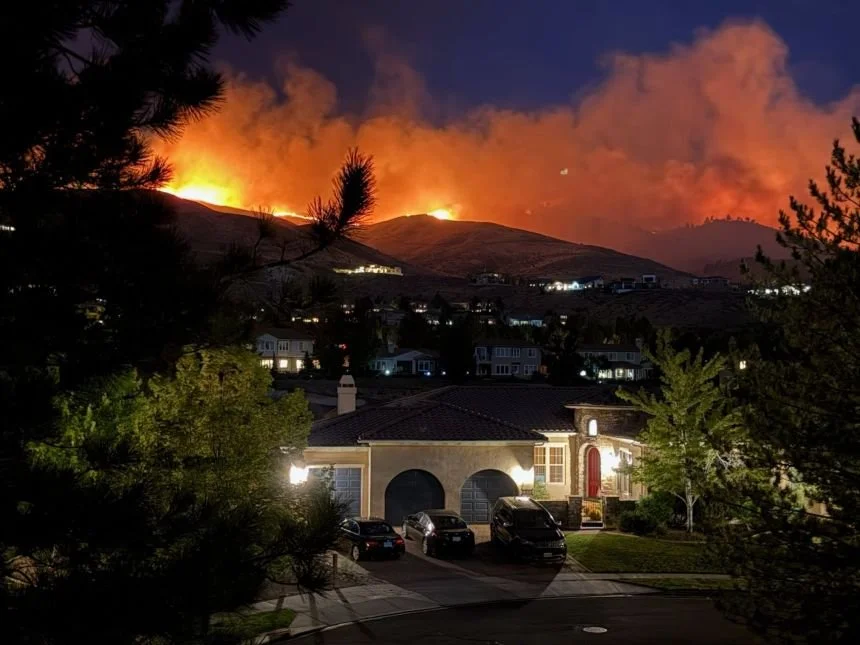
The Hawk Fire started northwest of Reno at about eleven on the morning of Saturday, August 22. I was out running errands when the alerts began.
If you have been near a wildfire before, you know access closes quickly. Our three dogs — Oscar, Connor and Jackson — were home alone, so while 90,000 of my neighbors were being urged to evacuate, I drove back toward the mountain.
The fire took the rest of the day to work across the ridge and reached us after dark. By the time our street received the evacuate now order, our cars were packed and pointed downhill.
We did not leave.
I share that carefully because nothing here is advice. We were not staying because we wanted to take a risk, but rather because we were weighing one risk against another. The roads below us were filling, and we were in a house we had recently built and invested heavily in making as resilient to fire as we reasonably could. The cars were ready, the dogs were in, and we would leave if the situation changed.
For the moment, we judged staying as safer.
Our lot sits high, with a clear view of the fire's front, so fire crews used our driveway as a staging ground. Eight engines parked where we normally unload groceries.
One never moved.
It stayed for twenty-four hours. Eventually we learned why: our insurance carrier had sent it. Several neighbors holding the same policy had their own.
Private fire protection, dispatched by contract, on a public street.
A CalFire dozer drove straight up our hill and cut a line. Water drops helped stop the fire. The water came from a friend's dam on the far side of the mountain.
We were fortunate. Forty-seven households were not. Roads closed and drivers sat in stationary traffic for hours. Some turned back because leaving had become harder than staying.
The losses were not distributed randomly. Neighborhoods with funded firebreaks and formal protection plans generally came through better. The North Valleys absorbed much of the destruction.
That night left me with one question I have not been able to put down:
Who gets the fire truck?
I have spent most of my career working on climate change, emissions, nature and the energy transition. That work still matters. Every tenth of a degree of warming is worth avoiding.
But the fire made visible the other half of the climate problem. Adaptation is not a future activity. It was happening on our street that night.
The engine in our driveway came through insurance. The water came off private land. Our option to stay longer than most had been paid for years earlier, in the way we built the house. The firebreaks and protection plans that spared some neighborhoods had been funded before anyone saw smoke.
Adaptation was working.
It was also being allocated.
The first problem is that the value adaptation creates is an avoided loss: a house that does not burn, a worker who does not miss a shift, a patient who never arrives at the hospital. If no institution can capture that value, no one has a clear reason — or budget — to invest. The second is that if protection follows only the assets and people best able to pay, adaptation can deepen the inequality it is meant to reduce.
Both problems are central to the work we set up HeatWve to do.
Our approach is simple: HEAT is the new SWOT.
H --- Hotter: Where is it getting hotter, and by how much?
E --- Economics: What are the consequences, and who is paying?
A --- Action: What can we do about them?
T --- Timing: What needs to happen now, and what can wait?
They sound like obvious questions. But in most organizations, different people answer them, if anyone does. The sustainability team maps the heat, finance sees the costs, operations decides what to do, and nobody owns the timing. HEAT is the new SWOT because it puts all four questions on one page.
For the past year, we have been using that framework with clients, including studying extreme heat's effects on human health across four American cities for a major foundation.
The public argument about extreme heat tends to begin with deaths. About 2,400 heat-related deaths were officially recorded in the United States in 2024. The real number is likely considerably higher because heat is often not identified on a death certificate when the immediate cause is recorded as cardiac, kidney or respiratory failure.
Even that misses most of the story.
Heat degrades how well a country lives and works every summer, whether or not anyone dies. It contributes to lost labor, hospital demand, lower production and higher household costs.
The people most at risk are not difficult to identify. They are disproportionately older, frequently living alone and often managing existing health conditions. In Maricopa County, Arizona, 85 percent of the air conditioners in homes where someone died of heat indoors were not working.
Research on Chicago's 1995 heat wave showed that social isolation was itself a major risk factor: living alone more than doubled the odds of dying, while regular contact with other people was protective. Adaptation, in other words, is not always glamorous. It can be a working air conditioner, an accessible cooling center, a shaded bus stop or a person knocking on a door.
The striking thing about our work has not been how much new technology is required, but how much of what works is already known. Many adaptation failures are not failures of invention. They are failures to assign responsibility.
Heat rarely arrives on a household expense line under the heading climate change. It arrives as a higher electricity bill, a rising insurance premium, a new medical expense, lost income or an unplanned hospital admission. If a risk never appears in a budget, nobody is responsible for managing it.
The same problem exists inside large institutions. Health systems pay for heat-related illness, but by the time the cost reaches finance teams, they see renal failure, respiratory distress or cardiovascular demand —not necessarily the heat wave that helped produce it.
The cost exists, but the cause — and therefore the owner of the solution —does not appear clearly in the accounts.
My insurer did not send a truck to our driveway because it had suddenly become a humanitarian organization. It sent one because it could connect an intervention today with a smaller loss tomorrow.
That alignment is what much of adaptation still lacks.
We often describe the challenge as a funding gap. I am not sure that is the whole diagnosis. There is enormous capital looking for places to earn a return. What is often missing is a buyer: an institution whose job it is to pay today for a disaster that does not happen tomorrow. "Nothing happened" is difficult to put on an invoice.
The details will differ by sector, but the principle is the same: make avoided loss something somebody can buy.
Who has a reason to prevent the house from burning down? Who benefits when the air conditioner works? Who avoids costs when shade is added to the bus stop? Who is responsible for checking on the person living alone?
HEAT is designed to expose those connections. Where is the physical risk changing? What will it cost if nothing is done? Which actions reduce that cost? Who benefits enough to pay? And when does acting become cheaper than waiting?
But the fire also showed me the danger of leaving adaptation entirely to the market.
Private insurance worked very well on our street. That is precisely the point. A system can be economically rational and still produce a bad social outcome if access to protection depends primarily on the value of an asset or the ability of each household to buy it.
Most households cannot arrange an insurer's engine, a friend's dam and a house built to withstand fire.
That is why adaptation cannot become a collection of bespoke defenses purchased one household at a time. Markets can identify value, reward prevention and move capital toward solutions. But public institutions and communities must set the floor — deciding what protection people should be able to expect and how to finance it before the emergency rather than after the loss.
The buyer of avoided loss might be an insurer, an employer, a utility, a health system or a government agency — or a coalition that can see costs no single organization captures on its own.
The Chicago finding is the one I keep coming back to. Someone knocking on the door saved lives. The institutional question is whether anyone has the responsibility, resources and reason to make sure the knock happened.
My insurer had a clear reason to protect our house. The harder question is who has the same reason to protect what sits on no one's balance sheet: the neighbor living alone, the worker waiting at an unshaded bus stop, the family in the North Valleys.
In Reno, for one night, I saw what is at stake.
There was a fire truck in my driveway.
The question is who else gets one next time.
Photo credit: Truckee Meadows Fire Protection